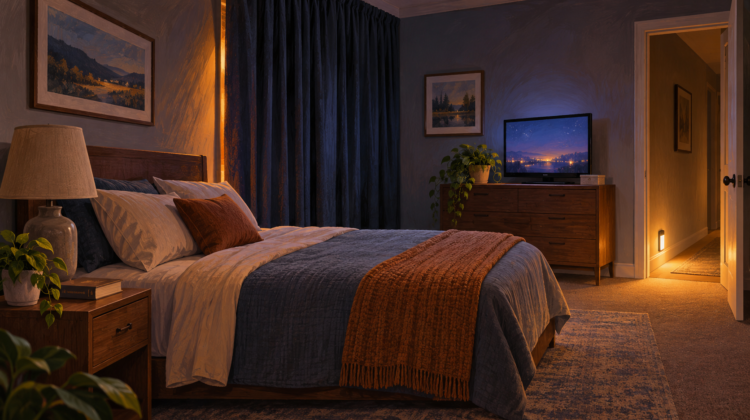
Original illustration. A bedroom example, not a medical result.
What the study found and what you can reasonably change tonight
The lamp is off, but the bedroom still has a glow. A television is running across the room. A display shines beside the bed. Streetlight finds the gap in the curtains.
Those are ordinary details, easy to stop noticing. A recent study gives us a reason to look at them again. The useful response is a calmer, more deliberate sleep setup, not a new fear that every illuminated clock is damaging your heart.
Our short video introduces the question. Here is the fuller explanation, including where the evidence ends and practical judgment begins.
What researchers actually measured
Jin Dai and colleagues published their observational UK Biobank study in the European Heart Journal on September 9, 2026. Participants wore a wrist light sensor for seven days. Researchers defined nighttime using each person's least-active five hours, rather than one fixed bedtime.
About 11,000 people had later heart imaging; a larger group contributed cardiovascular outcome data. Greater nighttime light exposure was associated with small differences in heart structure and function and higher rates of some cardiovascular problems. That establishes an association, not proof that light caused the differences.
The study adjusted for many other factors, but unmeasured differences could still contribute. One week may not represent long-term exposure. The cohort was predominantly White, and night-shift workers were excluded. Those limits matter when applying the findings to other people.
What this means for your bedroom
Wrist light measurements are not the same as light reaching your eyes. This observational study did not test bedroom changes as treatments, so it cannot establish that curtains, sleep masks or switching off a television prevent heart disease.
The video's character and room are fictional illustrations, not a record of a real person's medical outcome.
You can take a reasonable, low-cost step without pretending the science has answered every question. Start by asking which light you actually need and which light has simply become part of the furniture.
A room check that starts with what you have
Do this before you are exhausted and ready to fall asleep. Set the room up as you normally would, switch off the main lamp, and look around from the bed. You are identifying sources, not conducting a medical test.
The National Heart, Lung, and Blood Institute recommends a quiet, cool, dark bedroom, while explicitly allowing a dim nightlight when needed. Its sleep guidance also advises avoiding bright artificial light from televisions or computer screens before bed. Those are general sleep habits, not a treatment protocol derived from this new study.
Start with the television. If it is still playing after you stop watching, consider turning it off before you settle in. If you share the room, agree on a change that both people can live with. A routine you can repeat is more useful than a perfect-looking setup that causes an argument every night.
Next, check displays. Use a device's normal dimming or display-off setting if it has one. Keep alarms and any medically necessary equipment working as intended. The goal is to remove unnecessary light, not to interfere with something you rely on.
Then look toward the window. Adjust an existing curtain before assuming you need a replacement. If outdoor light remains a problem, more effective window coverings or a comfortable sleep mask may be options. CDC/NIOSH sleep-environment guidance discusses both. These are ways to manage light, not evidence that a particular product protects your heart.
Keep the route to the bathroom safe
Do not make the room so dark that getting up becomes hazardous. Keep the floor clear, and make sure you can reach a light when you need one. NIOSH guidance pairs reducing bedroom light with keeping the bathroom route clear and using a dim nightlight to see your way. NHLBI also makes room for a dim nightlight in its advice.
Your actual needs matter. A person who gets up frequently, has difficulty seeing or needs help moving around should not sacrifice safety to achieve a blackout effect. Think about where light is useful, rather than treating darkness as a competition.
What to expect after making a change
You may find the room more comfortable. You may discover that the light was not what bothered you. Either observation can help you decide whether to keep the change. Neither tells you whether your cardiovascular risk has changed.
Avoid turning a bedroom adjustment into another demanding health project. There is no need to score the darkness every night or make an expensive shopping list. Pick one obvious source you can comfortably reduce, preserve the lighting you need, and see whether the arrangement suits you.
These changes are not a proven way to prevent heart disease. Do not stop or change medication because of this study. If you have an ongoing sleep concern, discuss it with a healthcare professional rather than treating a curtain or a mask as the complete answer.
Tonight, after the main lamp goes off, take a look around. What is still lighting up your bedroom, and is there one source you do not need?
Educational information, not individual medical advice.

Leave a Reply